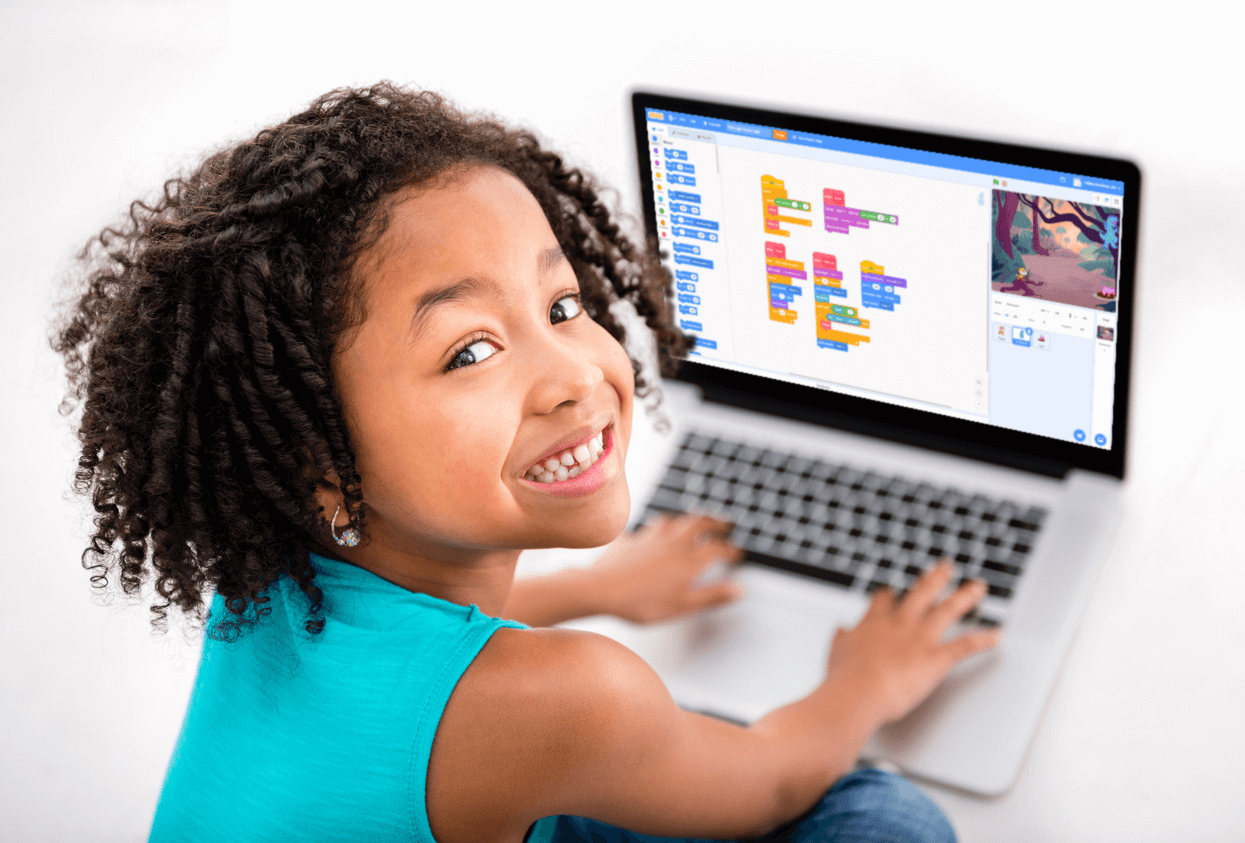
"What age should my child start coding?" is one of the most common questions Nigerian parents ask — and the answer is both simpler and more urgent than most parents expect.
The simple version: the right age to start coding is whatever age your child is right now.
The more complete answer — the one that actually helps you make a decision — requires understanding what age-appropriate coding looks like at each stage of your child's development, which tools are right for which ages, and what the compounding cost of waiting actually is. That is exactly what this article covers.
"A child who learns to code at 7 and one who starts at 14 are not in equivalent positions at 17. The gap compounds every single year."
The Honest Answer
Most parents imagine that coding is something that requires a certain level of maturity — perhaps secondary school age, perhaps after O-Levels. This intuition is understandable and almost entirely wrong.
Coding — when taught at the right level with the right tools — is accessible to children as young as 5 or 6. Not because coding has been "dumbed down" for young children, but because the foundational concepts of programming (sequencing, cause and effect, logical conditions) map directly onto the way young children naturally think and play.
The mistake is conflating "coding" with "typing Python into a terminal." That is one version of coding, appropriate for teenagers. But the same logical foundations — the same thinking patterns that eventually produce professional software engineers — can be built in a 7-year-old using visual block tools, and those foundations are exactly as valuable as the adult version that comes later.
💡 What the Research Says
MIT Media Lab research on children and computational thinking consistently shows that children who are exposed to programming logic before age 10 develop measurably stronger abstract reasoning, problem-solving, and mathematical thinking than those who are not — regardless of whether they go on to become programmers.
The Complete Age-by-Age Breakdown
Here is exactly what coding looks like at each age group — what children learn, which tools are appropriate, and what they can realistically build.
5–6Years
Pre-Coding Foundations
Scratch Jr · Kodable · Unplugged activities
Children aged 5–6 are not yet ready for formal coding instruction — but they are absolutely ready for the thinking skills that coding develops. At this age, the goal is building the cognitive foundations: sequencing (what comes first, what comes next), cause and effect (if I do this, what happens?), and basic logical reasoning.
🎯 Pattern recognition📋 Sequencing activities🎮 Scratch Jr games🧩 Unplugged puzzles
7–10Years
Starters — Scratch Block Coding
Scratch · FlipaClip · Ibis Paint X · Canva
Seven is widely considered the ideal starting age for formal coding education — and the research supports this completely. At this age, children can understand sequences, conditions, and loops when presented visually. This is exactly why MIT developed Scratch — the world's most widely used children's coding language — for this precise age group. No typing required. No frustrating syntax errors. Just immediate, visible results that keep children engaged and building.
Children in this age group at Learnovo Kids build animated stories, simple games with score tracking, interactive projects with keyboard controls, and basic simulations — all using Scratch's visual block interface. By the end of the Starters coding programme, every child understands loops, conditions, variables, and events — the four foundational concepts that underpin every programming language in the world.
✅ Ideal starting age🎮 Build real games🔁 Loops & conditions📦 Variables & events🚫 No typing needed
Ages 11–13 are the bridge years — the transition from visual block coding to real typed code. This transition is one of the most critical moments in a child's coding education, and it is the one most commonly handled badly. Children who are pushed into pure text-based code too fast without a proper visual foundation find it frustrating and often give up entirely.
At Learnovo Kids, our Explorers level bridges this gap deliberately. Children begin with advanced Scratch projects — multi-scene games, complex animations, interactive stories — that push the limits of what blocks can do. Then, we introduce Python slowly and intentionally, drawing explicit connections between the Scratch blocks they already understand and the Python syntax that expresses the same logic. By the end, children are writing real Python code with genuine understanding — not copying without comprehension.
🌉 The critical bridge🐍 Python introduction🌍 HTML & CSS🎮 Godot game engine⚠️ Don't rush this stage
14–17Years
Builders — Full Python & Real Projects
Python · FlutterFlow · Django · Pygame · VS Code
Teenagers aged 14–17 are cognitively ready for the full complexity of a professional programming language. Python is the clear choice for Nigerian teenagers — it is readable, powerful, and the primary language of Nigeria's growing tech sector, used by Paystack, Flutterwave, and most of the country's leading technology companies.
At Learnovo Kids, Builders-level students cover the complete Python foundation: data types, conditions, loops, functions, lists, dictionaries, file handling, and object-oriented basics. Every concept is taught through Nigerian-context real projects — a market price tracker, a student grade calculator, a WhatsApp message automation script — so the relevance is always immediate. Most Builders-level students leave the course with their first freelance enquiry already received.
🐍 Full Python📱 App development💼 Portfolio ready💰 First freelance income🏆 University-ready skills
⚡ Quick Reference — Age vs Starting Point
Ages 5–6
Pre-coding foundations — sequencing, logical thinking, Scratch Jr. Not formal coding yet, but builds the right foundations.
Ages 7–10 ✅ Ideal Start
Begin Scratch immediately. This is the perfect window. No prior experience needed. Children build real games within weeks.
Ages 11–13
Start with advanced Scratch then bridge to Python. Still an excellent time to start — do not skip the bridge phase.
Ages 14–17
Start directly with Python. Not too late at all — motivated teenagers make extraordinary progress and can be earning within months.
Which Tools Are Right at Each Age
Choosing the wrong tool for a child's age is one of the most common reasons children give up on coding early. A 7-year-old placed in front of a Python terminal will be frustrated and bored within 20 minutes. A 15-year-old kept on Scratch for more than a term will be equally disengaged. Here is the tool map that works:
Ages 5–6: Scratch Jr (iPad/Android app), Kodable, physical coding games and cards — no screens required at all for most activities at this age.
Ages 7–10: Scratch (scratch.mit.edu — completely free, browser-based, works on any device). No installation. No setup. Your child can start their first project in under 5 minutes.
Ages 11–13: Advanced Scratch for the first half, then Python using IDLE or Thonny (both free, both beginner-friendly). HTML and CSS using VS Code or even Notepad. Godot for game development (free, open-source, runs on any laptop).
Ages 14–17: Python in VS Code (the industry-standard environment). FlutterFlow for app development. Django for web backend projects. Pygame for game development. Git and GitHub for version control — a professional skill that dramatically improves university and job applications.
Signs Your Child Is Ready to Start Coding
Beyond age, there are behavioural signs that a child is particularly well-positioned to start coding right now — and they may surprise you.
They ask "how does it work?" about technology — curiosity about the mechanism behind things (games, apps, videos) is the single strongest predictor of coding aptitude.
They enjoy building things — Lego, drawing, making up stories, arranging objects into patterns. The creative and constructive instinct transfers directly to coding.
They are patient with repetitive tasks — coding requires trying the same thing multiple times with small changes. Children who can persist through repetition without losing interest are well-suited to it.
They like puzzles or logic games — children who enjoy noughts and crosses, chess, word puzzles, or mathematical pattern games are already exercising the exact cognitive muscles that coding develops.
They love video games — children who love playing games almost always become passionate about building them. This is one of the most reliable entry points into coding for Nigerian children aged 8–14.
A Note for Nigerian Parents
Many Nigerian parents worry that their child is "not a maths person" and therefore not suited to coding. This is a misconception worth addressing directly. At the Starters and Explorers levels, coding requires almost no formal mathematics. It requires logical thinking, creative problem-solving, and patience — qualities that are equally distributed across all children, regardless of their relationship with school mathematics. Some of the strongest coders at Learnovo Kids have been children who actively disliked maths class.
The Three Mistakes Nigerian Parents Make
Waiting Until the Child "Shows Interest"
Most children will not spontaneously show interest in coding — because they have never been exposed to it in a way that reveals what it can do. The interest typically comes after a first session where they build something that works. Waiting for interest before exposure is like waiting for a child to show interest in reading before you introduce them to books.
Choosing Pre-Recorded Video Courses Over Live Instruction
Free coding video courses are widely available and widely ineffective for children. Self-directed learning requires executive function skills — planning, motivation, self-accountability — that most children do not yet have. Live, instructor-led classes with real accountability produce outcomes that self-paced video courses simply cannot match for the vast majority of Nigerian children.
Placing Children in the Wrong Age Group
Placing a 9-year-old in a class designed for 14-year-olds — because the parent wants them to be "challenged" — is one of the most reliable ways to produce discouragement. Age-appropriate instruction is not about limiting children. It is about building genuine understanding at the right depth and complexity for the child's current cognitive stage. Learnovo Kids assesses every child at enrolment and places them in the group where they will thrive — not simply the group that matches their chronological age if a different level is more appropriate.
Ready to find the right level for your child?
WhatsApp us — we will recommend the perfect course and track in under 5 minutes.
Absolutely not. Fourteen is a genuinely excellent age to start coding — perhaps the best age for highly motivated learners. Teenagers have the cognitive capacity to absorb Python fundamentals quickly, the maturity to persist through frustrating bugs, and enough time before university to build a real, impressive portfolio. Several Learnovo Kids students who started at 14 or 15 have had their first freelance client within 6 months of completing their first course.
Yes — completely. Scratch, the tool we use for all Starters-level coding, requires zero typing. Children drag and snap visual blocks together using a mouse, trackpad, or even a touchscreen. The first several months of coding education at Learnovo Kids involve no typing at all. Typing speed is entirely irrelevant to coding ability at this age, and the logical thinking skills built in Scratch transfer directly to text-based languages when the time is right.
This depends on what you mean by "learn to code." A 9-year-old can build a real, playable game in Scratch within 4 weeks of starting. A 15-year-old can write useful Python programmes within 8–10 weeks of consistent instruction. Building the depth of coding knowledge needed for a professional software engineering role takes several years of consistent learning and practice — which is exactly why starting early compounds so dramatically in value.
For children aged 7–10, coding and creative digital skills (Digital Art, Animation, Graphic Design) are equally valuable starting points — the best choice is whichever one your child is most excited about. Enthusiasm is the most important variable in early digital education. For children aged 14+, coding is the highest-leverage foundation because it opens doors to app development, game development, web design, and AI — skills that build directly on programming knowledge.
For Starters-level coding (Ages 7–10) using Scratch, any device with a browser works — smartphone, tablet, laptop, or desktop. For Explorers and Builders-level coding (Ages 11–17) using Python, a basic laptop or desktop is recommended. Scratch runs entirely in a browser with no installation. Python requires a free installation that takes under 5 minutes. Learnovo Kids sends a complete setup guide to every family before their first session.