🔐
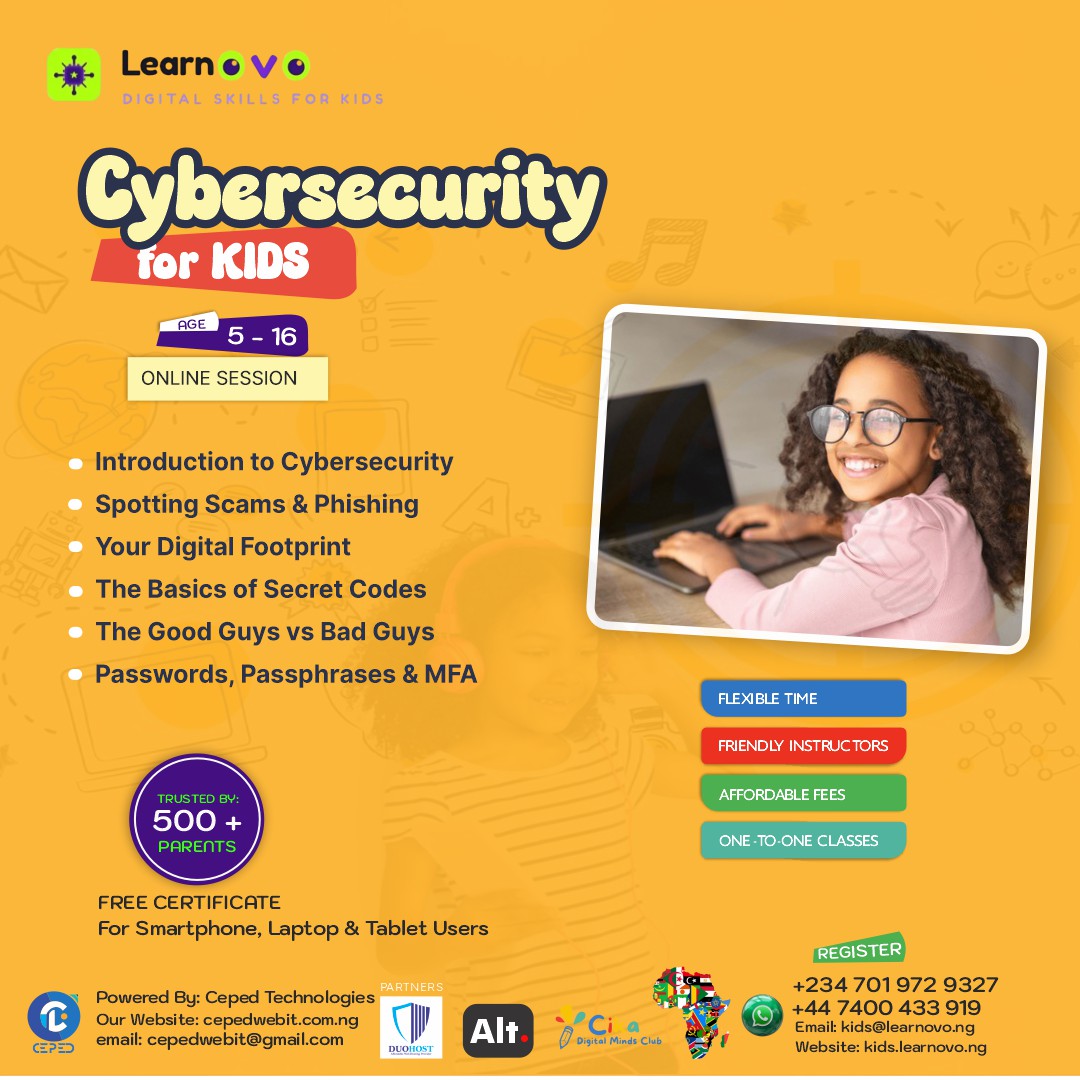
Cybersecurity · Learnovo Kids
Nigeria loses over $500 million to cybercrime every year — one of the highest rates in Africa. Behind those numbers are real families whose bank accounts were emptied, social media accounts hacked, and personal data stolen. Cybersecurity for kids is not a niche tech topic. It is a survival skill in modern Nigeria.
Why Nigerian Children Specifically Need Cybersecurity Education
Nigeria has a particularly high rate of online fraud, phishing, social engineering, and account takeovers. Nigerian children are targeted because they are trusting, often share personal information freely, and are less likely to recognise digital threats.
At the same time, Nigeria desperately needs cybersecurity professionals. There are fewer than 2,000 trained cybersecurity professionals in Nigeria for a country of 220 million people. Children who learn cybersecurity early are entering one of the most under-supplied, highest-paid careers in Nigeria's tech sector.
📊
Career data: Cybersecurity professionals in Nigeria earn ₦500,000–₦2,000,000+ per month depending on specialisation. Working remotely for international companies, they earn in dollars. This is one of the highest-value tech careers a Nigerian child can pursue.
What Children Learn in the Cybersecurity Basics Course
How Attacks Actually Work
Children learn the basics of how hackers operate — not to hack, but to defend. Understanding phishing emails, social engineering tactics, password cracking, and malware helps children recognise and resist these attacks in real life. Many of our students have used these lessons to protect their own families from online scams.
Password Security and Authentication
Most Nigerians use weak passwords and reuse them across multiple accounts. Children learn what makes a strong password, how password managers work, and why two-factor authentication is essential. This is immediately practical and applicable.
Network Security Fundamentals
What happens when you connect to public WiFi in a Nigerian café or mall? Children learn about network vulnerabilities, VPNs, and why some connections are more dangerous than others.
Identifying Phishing and Scams
Nigeria is famous for email and social media scams — and many Nigerians fall for them, including adults. Children learn to spot fake websites, fraudulent emails, and deceptive social media messages. One of our students used this skill to stop his uncle from transferring money to a fraudulent account.
Digital Privacy
How apps collect data, what permissions mean, and why oversharing personal information online creates risk. This connects directly to our Digital Citizenship course.
Introduction to Ethical Hacking Concepts
For older students, we introduce the concept of ethical hacking — using security knowledge to find and fix vulnerabilities, rather than exploit them. This is the foundation of a cybersecurity career and one of the most exciting and engaging parts of the course.
👩👧
Student story: "Kalu, 13, came home from class and told his uncle not to send money to a 'friend' asking via WhatsApp — he recognised it as a social engineering scam. His uncle would have lost ₦150,000. Kalu learned how to spot this in week 3 of the cybersecurity course." — Mr Nwachukwu, Owerri
Is Cybersecurity Too Advanced for Children?
Not at all. We teach cybersecurity concepts through games, puzzles, real-world scenarios, and age-appropriate projects. Children aged 9 regularly grasp concepts that confuse many adults — because they are taught practically, not theoretically.
The cybersecurity course pairs naturally with our Coding with Python course for children who want to go deeper into the technical side, and with Digital Literacy and Digital Citizenship for a complete online safety education.
Give your child the skills to stay safe — and build a career in security.
Cybersecurity course for Nigerian children ages 9–17.
🔐 See Cybersecurity Course